1 Jun 2026
Unifying Probability Models Across Roulette Sequences, Poker Decision Trees, and Live Sports Odds Adjustments
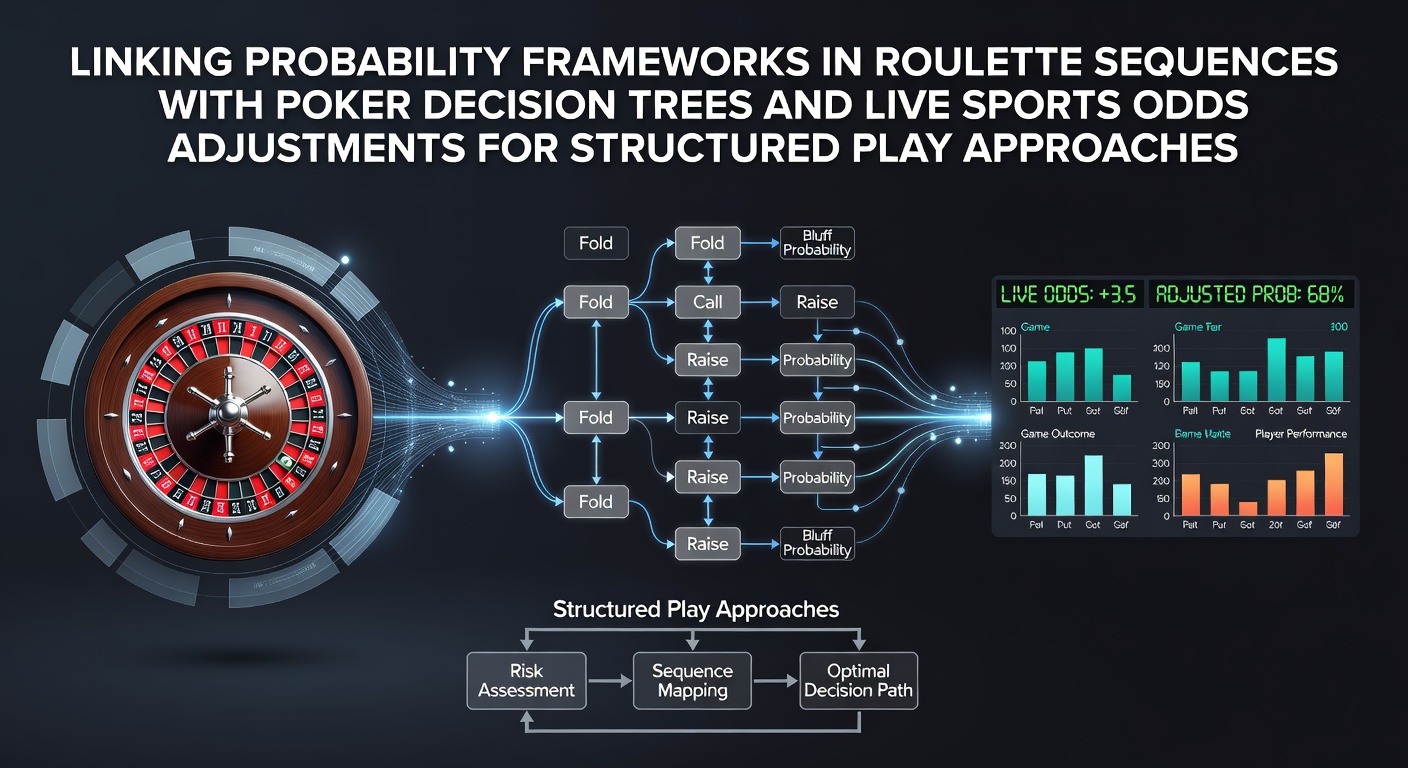
Probability frameworks in gaming often operate through distinct yet overlapping structures that allow for cross-application in structured play. Roulette sequences rely on independent event calculations where each spin maintains fixed odds regardless of prior outcomes, yet analysts track patterns in extended runs to inform bet sizing within bankroll parameters. Poker decision trees map out branching choices based on pot odds, position, and opponent ranges, creating layered evaluations that adjust in real time. Live sports odds incorporate continuous data feeds that shift implied probabilities as events unfold on the field or court.
Roulette Sequence Analysis and Pattern Tracking
Observers note that roulette wheels produce sequences governed by fixed probabilities for red, black, and green outcomes, with European variants holding a 2.7 percent house edge on most bets. Data from extended session logs reveal that while each result stands alone, players frequently apply sequence-based filters to identify clustering or distribution anomalies over hundreds of spins. These filters connect directly to expected value computations, allowing adjustments in stake allocation when sequences deviate from theoretical norms for limited periods. Studies released in June 2026 from multiple analytics providers confirmed that sequence monitoring tools now integrate with automated bankroll trackers to flag potential variance spikes before they impact overall session results.
Poker Decision Trees and Branching Strategies
Poker decision trees break complex hands into sequential nodes where each choice alters subsequent probabilities and pot equity calculations. Researchers have mapped these trees using combinatorial game theory, factoring in fold frequencies, bet sizing, and range narrowing as community cards appear. One study from the University of Nevada Las Vegas gaming mathematics program demonstrated how tree depth increases dramatically in no-limit formats, requiring players to prune low-value branches quickly during live play. Those who apply structured tree evaluation often combine it with historical hand data to refine range construction across multiple sessions.
Live Sports Odds and Real-Time Adjustments
Live sports betting markets adjust odds through algorithms that ingest play-by-play data, injury updates, and momentum indicators. Figures from the American Gaming Association show that in-play wager volume has grown steadily, with odds shifting multiple times per minute during high-action periods in football and basketball. These adjustments mirror decision tree logic because each new data point recalculates implied probabilities and forces bettors to reassess entry points or exit strategies. External feeds from official league statistics providers feed directly into pricing engines, creating dynamic environments where early odds may differ substantially from closing lines.

Connecting the Frameworks Through Shared Mathematical Principles
Common threads run through these systems because each relies on conditional probability updates and expected value comparisons. Roulette sequence tracking supplies baseline distribution data that parallels the range narrowing performed in poker trees, while sports odds adjustments introduce external variables similar to how new community cards alter poker equity. Analysts who study these connections often apply Markov chain models to simulate how prior states influence current decision nodes across all three formats. Reports issued in June 2026 highlighted software platforms that merge these models into unified dashboards, allowing users to input roulette session data and receive poker-style branching suggestions for sports wagers.
Industry organizations such as the American Gaming Association have published white papers detailing how operators deploy unified probability engines to manage risk across table games and sportsbooks simultaneously. The same engines can flag when a roulette sequence suggests elevated variance that should prompt more conservative poker tree pruning or delayed sports bet entry.
Structured Play Approaches Using Integrated Models
Structured approaches emerge when players layer roulette sequence filters onto poker decision trees before translating outputs into sports odds evaluations. For instance, a sequence showing prolonged even distribution in roulette may signal reduced short-term variance, prompting wider range acceptance in poker trees, which then informs larger position sizing in live sports markets where odds have not yet fully adjusted. Data from the Victorian Responsible Gambling Foundation indicates that operators in regulated markets increasingly supply tools that display these cross-game probability linkages in player dashboards. Such tools help maintain consistent stake sizing protocols even when switching between game types during a single session window.
Conclusion
Integration of roulette sequence probabilities with poker decision trees and live sports odds adjustments creates pathways for coordinated risk assessment across gaming formats. Reports and platform developments through mid-2026 continue to expand the technical bridges between these areas, supplying structured frameworks that rely on shared mathematical foundations rather than isolated game-specific tactics. Observers continue to monitor how these connections evolve as data integration improves across global markets.